
You’ve spent months crafting the perfect SEO strategy. Your blog posts rank on page one. Your content is optimized, your keywords are targeted, and your backlinks are solid.
But here’s the reality check: while you’re celebrating your Google rankings, your potential customers are asking ChatGPT, Perplexity, and Claude for recommendations. And when AI platforms generate those answers, your brand is nowhere to be found.
The shift is real. According to new research, 55% of respondents reported turning to AI for search rather than search engines.
If you’re not tracking how these platforms mention your brand (or if they mention it at all), you’re flying blind in the new era of search.
This guide shows you how to track brand mentions in AI search, what the data means, and what to do with it.
What is AI Search?
AI search is fundamentally different from typing keywords into Google and clicking through blue links. When someone uses an AI search, they ask conversational questions and get synthesized answers that pull information from multiple sources.
Think of it this way: traditional search shows you where to find information. AI search gives you the information directly, often without requiring any clicks.
There are usually two ways to conduct an AI search: AI overviews and AI chats.
Let’s learn more about that….
AI Overviews
Google’s AI Overviews appear at the top of search results for certain queries. Instead of showing ten blue links, Google’s AI gathers information from multiple sources and presents a comprehensive answer.
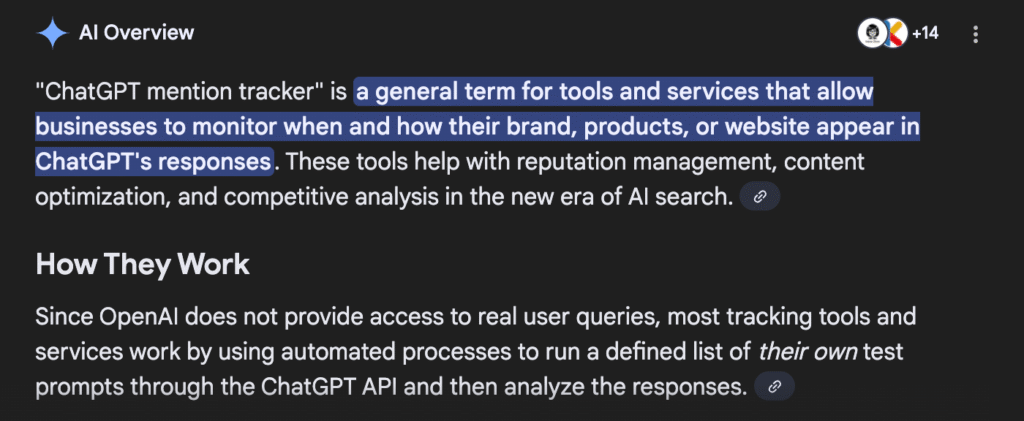
When you search for something like “best chatgpt mention tracker,” you might see an AI Overview that already provides a direct answer to your question, and then the list of the trackers.
If your brand appears in these AI Overviews, you’re getting visibility even if users never click through to your website. Your brand name, product features, and value proposition are being presented to potential customers at the exact moment they’re researching solutions.
AI Chats
AI chat platforms, also known as large language models (LLMs), such as ChatGPT, Claude, Perplexity, and Google Gemini, work differently. Users have conversational exchanges with AI assistants that can access current web information through search functionality.
Someone might ask:
“I need a ChatGPT mention tracker for my marketing agency. What are my options?”
The AI generates a response based on its training data and real-time web searches, potentially mentioning your brand alongside competitors.
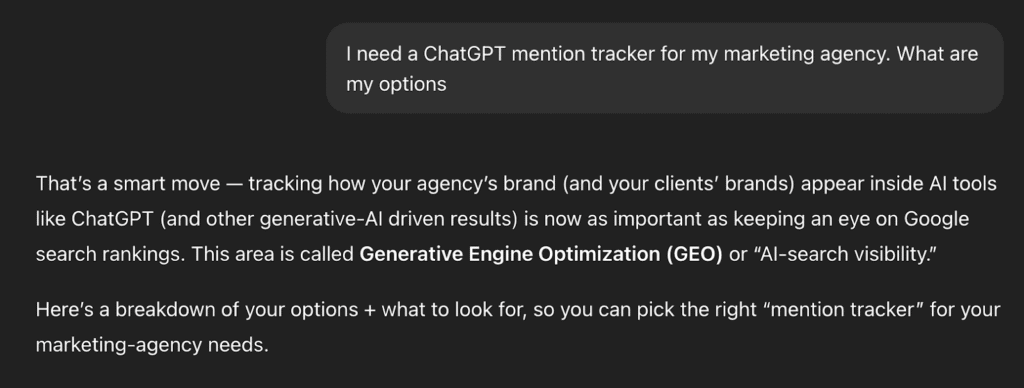
These conversations often happen early in the buyer’s journey. People use AI chats to explore options, understand solutions, and narrow down choices before they ever visit a website or contact sales.
Ways to Track Brand mentions in AI search
Tracking your brand mentions isn’t optional anymore. It’s essential for understanding how potential customers discover you. Here’s how to do it effectively.
Track Manually
Manual tracking gives you immediate insights without investing in tools. It’s time-consuming, but it helps you understand what’s happening right now.
Start by thinking like your customers. What questions would they ask AI platforms when looking for solutions in your space?
Create a list of prompts:
- Direct brand queries: “What is [Your Brand]?” or “Is [Your Brand] worth it?”
- Comparison queries: “How does [Your Brand] compare to [Competitor]?”
- Category queries: “What are the best [your category] for [specific use case]?”
- Alternative queries: “What are alternatives to [Competitor]?”
- Industry queries: “Who are the top companies in [your industry]?”
Type these prompts into ChatGPT, Claude, Perplexity, and Google (to see AI Overviews). Document what you find. Does your brand appear? Where in the response? What context surrounds the mention?
Important note: AI responses vary by location, user history, and timing. Ask colleagues in different locations to test the same prompts. You’ll often get different results, which tells you how consistently (or inconsistently) your brand appears.
The manual method works for initial exploration. But if you want to track dozens of prompts over time, compare against competitors, or measure the impact of your optimization efforts, you need a more systematic approach.
How to Track Brand Mentions on ChatGPT Using a GEO Tool
GEO (Generative Engine Optimization) tools automate tracking and provide data you cannot gather manually. These tools monitor how AI platforms mention your brand across multiple prompts over time.
GenRank specializes in ChatGPT tracking. Here’s how to use it:
Step 1: Sign up for GenRank
Create a free account at GenRank.io.
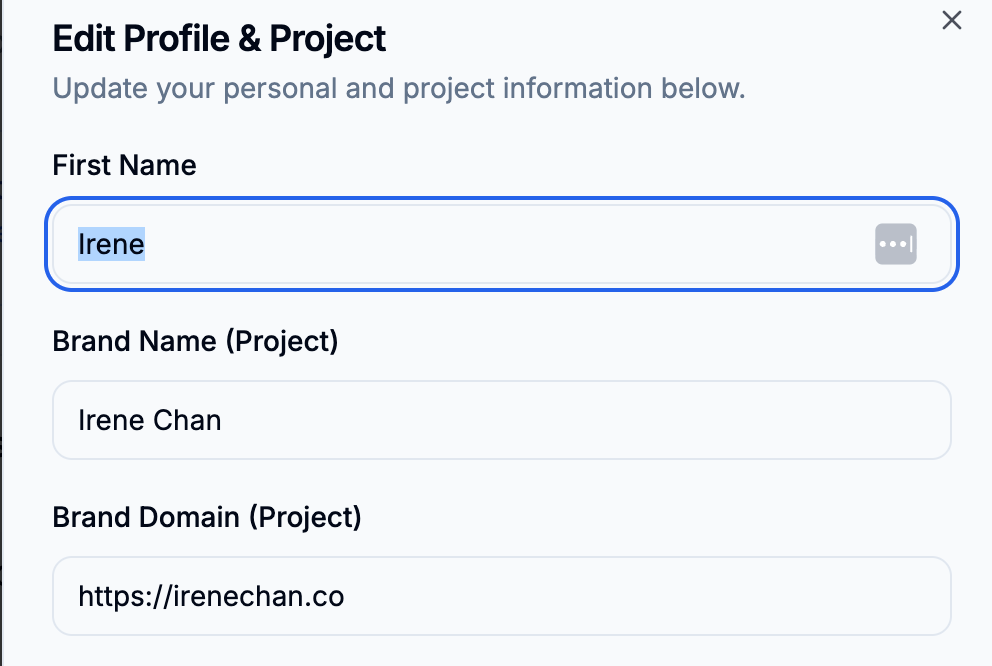
Step 2: Add your brand
Enter your brand name and website. GenRank will monitor for mentions of your brand in ChatGPT responses.
Step 3: Create relevant prompts
Add the prompts your target audience would actually ask. For example, if you’re an SEO agency, you might track:
- “What’s the best SEO agency?”
- “How much does SEO cost?”
- “What are things to ask an SEO agency before working with them?”
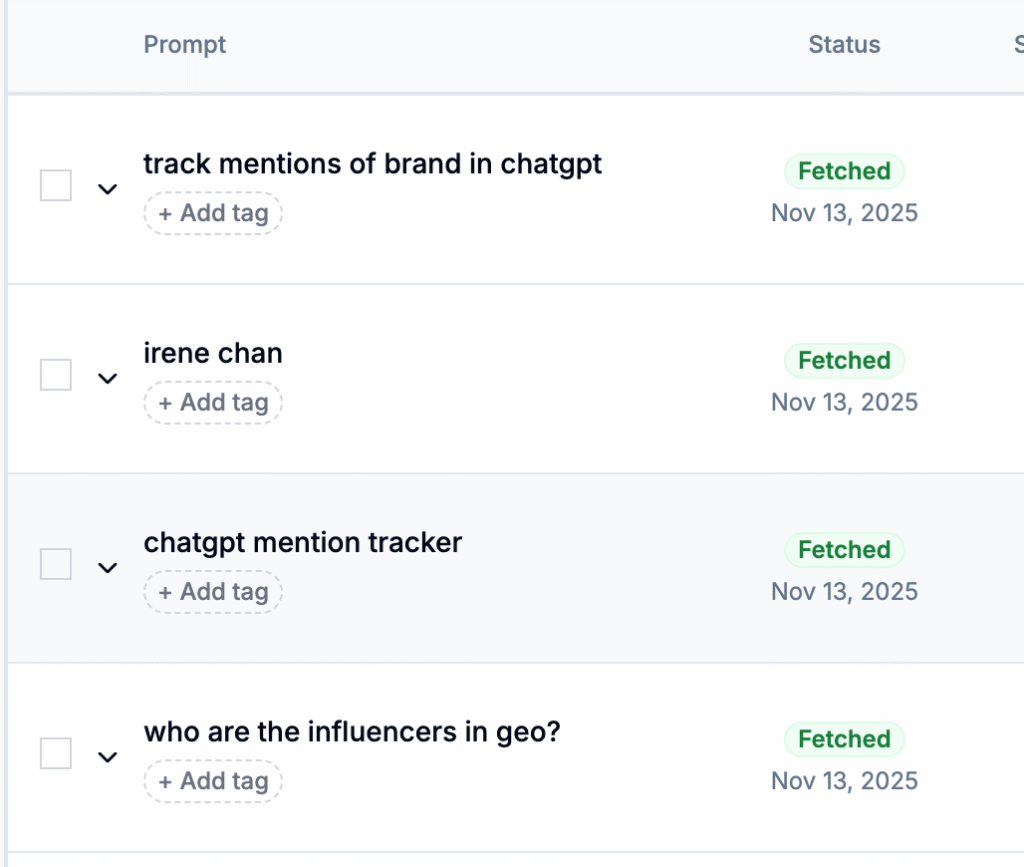
The key is specificity. Generic prompts rarely reveal useful insights. Focus on the exact questions your potential customers ask when they’re researching solutions.
If you’re already publishing consistent content, try to ask questions related to your blog post. If you have a blog post about the best time to travel in Taiwan, ask the question: “When is the best time to travel to Taiwan?” Is your blog post cited when you ask this question?
Step 4: Analyze the data
GenRank’s dashboard shows you:
- Brand mentions: How many times your brand name appears in the response
- Total citations: Total number of citations in the response
- Brand citations: Number of citations that reference your brand
- Citation position: Position of your brand’s first citation (1 is best)
Step 6: Track over time
The real value comes from monitoring trends. Are your mentions increasing after you published new content? Did a competitor surge ahead? Is your brand consistently mentioned for certain types of queries but missing from others?
GenRank’s timeline view shows how your optimization efforts impact your AI visibility. This data tells you what’s working and where to focus next.
You can also track brand mentions in ChatGPT specifically to understand how the most popular AI platform presents your brand.
What to Do Next
Tracking is just the beginning. The real question is: what do you do with this information?
Run a GEO Audit
Before you start creating content or making changes, you need to understand where you stand. A comprehensive GEO audit checklist helps you identify gaps and prioritize improvements.
Your audit should cover:
- Technical accessibility: Can AI bots crawl your site? Check your robots.txt file to ensure GPTBot, ClaudeBot, and other AI crawlers have access.
- Content structure: Is your content formatted for easy AI extraction? Clear headings, bullet points, and standalone sections help AI platforms understand and cite your content.
- Entity signals: How consistently does your brand information appear across the web? Inconsistent details confuse AI systems.
- Content gaps: What topics do competitors cover that you don’t? Where are they getting mentioned that you’re not?
Start with high-impact, low-effort fixes. Adding FAQ schema to your blog posts, updating your robots.txt file, and ensuring your About page has accurate, comprehensive information can improve visibility quickly.
Understanding SEO vs AEO vs GEO helps you see how these optimization approaches complement each other.
Write Articles That Answer Queries on AI Search
AI platforms prioritize content that directly answers user questions with clarity and authority. Your content strategy needs to reflect how people actually ask questions.
The difference is subtle but critical. Someone might Google “project management software.” But when they ask ChatGPT, they phrase it as: “What’s the best project management software for a startup with remote team members who need time tracking and budget management?”
Learn how to write blog posts so AI platforms will cite them with proven techniques that improve your chances of getting mentioned. Specialized tools can make this process easier. For example, HubSpot’s AEO tool automatically suggests content topic and format ideas using your existing brand mentions to further improve visibility.
Continue to Monitor
Tracking brand mentions isn’t a one-time project. It’s an ongoing practice that helps you understand what’s working and adjust your strategy.
Set up a regular monitoring schedule:
- Weekly: Check your top priority prompts to catch any sudden changes
- Monthly: Review overall trends, compare against competitors, and identify new opportunities
- Quarterly: Conduct a comprehensive analysis of your AI visibility across all platforms and prompts
As you publish new content, update existing pages, or launch products, monitor how these changes affect your AI visibility. The data tells you what resonates with AI platforms and what doesn’t.
Remember, AI platforms update their models, change their algorithms, and evolve their citation preferences. What worked last month might not work next month. Consistent monitoring helps you stay ahead of these changes.
Keep Going
The brands dominating AI search didn’t get there by accident. They started tracking, understood what worked, and adjusted their content accordingly. Now it’s your turn. Start with manual tracking to understand your current visibility, then implement a systematic approach with GEO tools like Genrank to monitor and improve over time.
The sooner you understand your AI visibility, the faster you can optimize for it.
FAQs About Tracking Brand Mentions in AI Search
Is it possible to track brand mentions in AI search?
Yes, you can track brand mentions through both manual methods and specialized GEO tools. Manual tracking involves asking specific prompts on AI platforms and documenting where your brand appears. GEO tools like GenRank automate this process by monitoring multiple prompts across AI platforms over time, showing you mention frequency, citation position, and trends.
Can I prioritize audit findings by impact in AI search optimization/GEO platforms?
Absolutely. Start with high-impact, low-effort technical fixes, such as updating your robots.txt file and adding schema markup. Then focus on content gaps where competitors consistently appear but you don’t. Prioritize based on business relevance—if a specific prompt directly relates to your core offering and you’re not mentioned, that’s a high-priority fix.
How can I see brand mentions in ChatGPT?
Ask ChatGPT specific questions your customers would ask about your industry, products, or services. Type prompts like “What are the best [your category]?” or “How does [Your Brand] compare to [Competitor]?” Document whether your brand appears in the response, where it’s positioned, and what context surrounds the mention. Repeat this across different prompts to understand your overall visibility.
Is there a tool to track brand mentions in ChatGPT?
Yes, GenRank specifically tracks brand mentions in ChatGPT. It monitors your chosen prompts, captures ChatGPT’s responses, and analyzes where your brand appears (or doesn’t appear). The platform shows you mention frequency, citation position, competitor comparisons, and trends over time. There is a free trial available!
How often should I track brand mentions in AI search?
Track high-priority prompts weekly to catch significant changes quickly. Run comprehensive monthly analyses to identify trends and compare against competitors. Conduct quarterly deep dives to evaluate your overall AI visibility strategy and adjust your approach. Increase frequency when launching new products, publishing major content, or making significant website changes.