What you need to know:
Ads aren’t live yet: OpenAI says it will start testing in the U.S. in the coming weeks (internal testing first). Where they show up: initial format is ads at the bottom of answers, triggered by the current conversation context. Who sees ads: planned for Free + Go tiers in the test; no ads on Plus, Pro, Business, Enterprise, Edu. Where the test starts: U.S. only, for logged-in adults; no ads for under-18 accounts. What topics are blocked: ads won’t appear near health, mental health, or politics (and other sensitive/regulated areas). What ads look like: clearly labeled, separate from the answer, with controls to see why and dismiss. How to advertise / pricing / ads manager: not announced yet. No public self-serve program, pricing, or “ChatGPT Ads Manager” details so far.
On January 16, 2026, OpenAI published its first clear roadmap for bringing advertising into ChatGPT. This isn’t a surprise to anyone who’s watched “AI Search” collide with e-commerce and discovery, but it is a major milestone: ChatGPT ads are officially on the way.
From a brand perspective, this matters for one reason above all: the interface where people ask “what should I buy / use / choose?” is becoming monetized. And unlike traditional search ads, where users scan a list of links, ChatGPT is an answer-first product. Ads will sit next to trust, not just next to content.
OpenAI’s positioning is also notable. They’re framing ads as a way to “expand access” (more people using ChatGPT without paying), while committing to a set of guardrails meant to preserve what makes ChatGPT valuable: answer independence, conversation privacy, and user control.
Below is everything OpenAI has shared so far, plus what’s still unknown.
When will ads launch in ChatGPT?
Ads are not live yet. OpenAI says it plans to start testing ads in the U.S. “in the coming weeks.”
The Help Center adds that this is internal testing and “not live externally yet,” and that eligible users will see clear in-product information when the test begins.
What’s not known yet:
- the exact start date
- how long the test will run
- when/if this expands beyond the initial test group
Where will ads appear in ChatGPT?
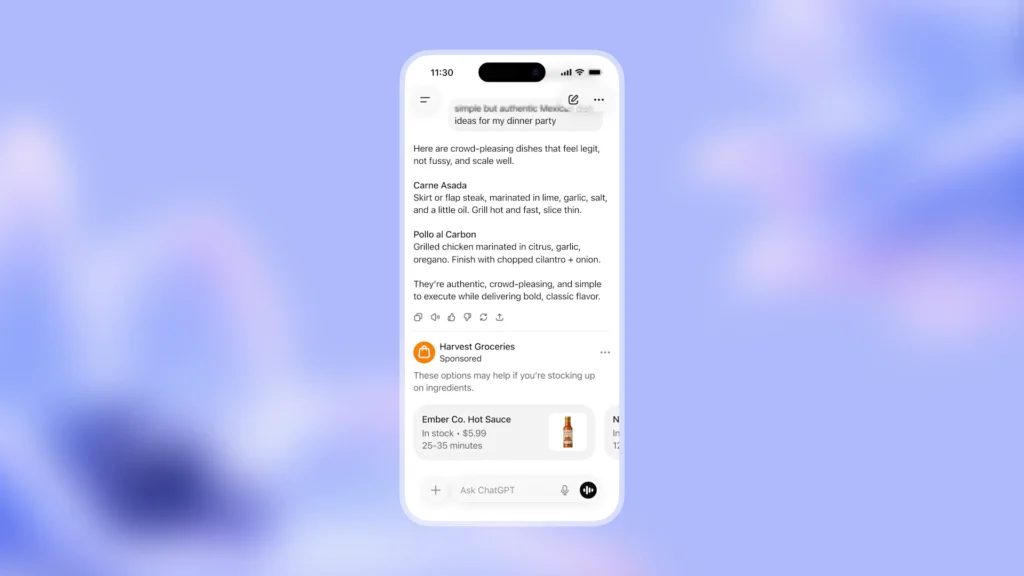
OpenAI’s initial ad placement is specific: ads will appear at the bottom of answers when there’s a “relevant sponsored product or service” based on the user’s current conversation.
We’ll have to wait and see how this gets implemented, but the conversation context will probably play a big role here.
What do ChatGPT ads look like?
OpenAI says ads will be:
- clearly labeled
- separate from the organic answer
- shown in a way that makes it obvious what’s an ad and what’s an answer
They also say users will be able to:
- learn why they’re seeing an ad
- dismiss an ad and provide a reason
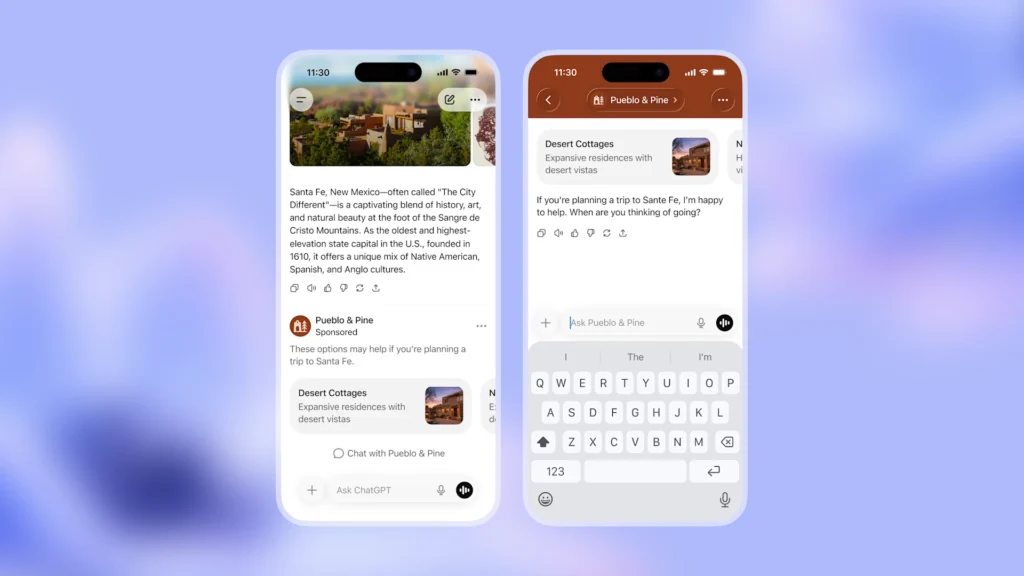
OpenAI included example mockups in their announcement showing sponsored modules beneath answers, and they hinted at future experiences where users might ask questions directly about an ad to support purchase decisions.
Which plans will get ads?
As announced for the test:
- Free and Go tiers: planned to receive ads (in the U.S. test)
- Plus, Pro, Business, Enterprise, and Edu: will not include ads
OpenAI also says it will “always offer a way to not see ads,” including a paid ad-free tier.
What countries are ChatGPT ads launching in?
The initial plan is U.S.-only: OpenAI will test ads with logged-in adults in the United States on Free and Go.
No international launch dates have been announced.
What topics can ads appear on (and where are ads blocked)?
OpenAI states ads are not eligible to appear near “sensitive or regulated topics,” including:
- health
- mental health
- politics
They also say they won’t show ads to accounts where the user tells OpenAI (or OpenAI predicts) the user is under 18.
What’s not known yet:
- the full category policy list (beyond the examples above)
- how “sensitive topics” will be detected and enforced in practice
How can brands advertise on ChatGPT?
Right now: you can’t yet via a public program.
OpenAI has announced testing and principles, but has not opened a self-serve product or public signup. They repeatedly frame this as early-stage testing and say they’ll share more after learning from feedback.
What brands can do immediately:
- Prepare landing pages for “AI intent” (clear positioning, pricing, proof, FAQs).
- Identify your highest-intent conversational entry points (see “Prompt research” below).
- Build measurement hooks (UTMs, dedicated pages, “how did you hear about us,” etc.) so you’re ready the moment traffic starts.
How much will ChatGPT ads cost?
Not announced. There’s no published pricing, auction model, bidding mechanics, or billing method yet.
Until OpenAI publishes specifics, any CPM/CPC/CPA numbers are guesswork.
Will there be a ChatGPT Ads Manager?
Also not announced. OpenAI has not confirmed:
- whether there will be a self-serve Ads Manager UI
- campaign/ad group structure
- targeting controls
- reporting dashboards
- attribution/conversion measurement features
For now, the only concrete statement is that ads will be tested and refined over time.
Do ads influence ChatGPT answers?
OpenAI’s answer is an explicit no: ads “do not influence the answers ChatGPT gives you,” and ads will be “separate and clearly labeled.”
This is the core promise they’re making to protect user trust: ads are an adjacent unit, not part of the reasoning for the response.
Tracking ads in ChatGPT: what brands should monitor
As soon as ads start showing, brand visibility splits into two streams:
- Organic visibility (being recommended / cited naturally)
- Paid visibility (showing up as a sponsored product/service)
Brands could monitor:
- Sponsored vs. organic overlap: are you paying for exposure you already get organically?
- Competitive conquesting: which competitors show up on your brand-adjacent prompts?
- Prompt-level share of voice: where you appear, where you don’t, and where ads shift outcomes.
- Message consistency: do ads reinforce (or contradict) how ChatGPT describes your brand?
Prompt research for ChatGPT Ads: how to prepare before ads go live
OpenAI says ads will appear based on the current conversation. That means “prompt research” becomes the new keyword research.
A practical workflow for brands:
1) Identify your “money-moment” prompts
Examples:
- “best [category] for [use case]”
- “[category] pricing”
- “[category] alternatives to X”
- “compare X vs Y”
- “recommend a tool that can…”
2) Cluster prompts by intent
A simple structure:
- Discovery: learning / exploring
- Consideration: comparing / shortlisting
- Decision: ready to choose / buy / implement
3) Map each cluster to a landing page + proof
For each prompt cluster, define:
- the best next click (page)
- the best proof (reviews, integrations, ROI, case studies)
- the best “fit statement” (who it’s for / who it’s not for)
4) Capture today’s baseline organic reality
Before ads change behavior, document:
- when ChatGPT already recommends you
- who it recommends instead
- what sources it cites when it talks about your space
The bigger picture: paid AI visibility is its own category
Search ads built a massive ecosystem because they monetized explicit intent (“buy running shoes”). ChatGPT ads will monetize something even richer: contextual intent inside conversations.
OpenAI is trying to thread the needle – monetization without breaking trust – by committing to:
- answer independence
- conversation privacy
- choice and control
- not optimizing for “time spent”
Whether they succeed will shape the next era of marketing. Either way, one thing is already true:
If your buyers use ChatGPT, your brand is already being evaluated there. Ads or no ads.
This article will be updated as more information becomes available.
We highly recommend reading more about how to get your business to show up on ChatGPT beyond ads: