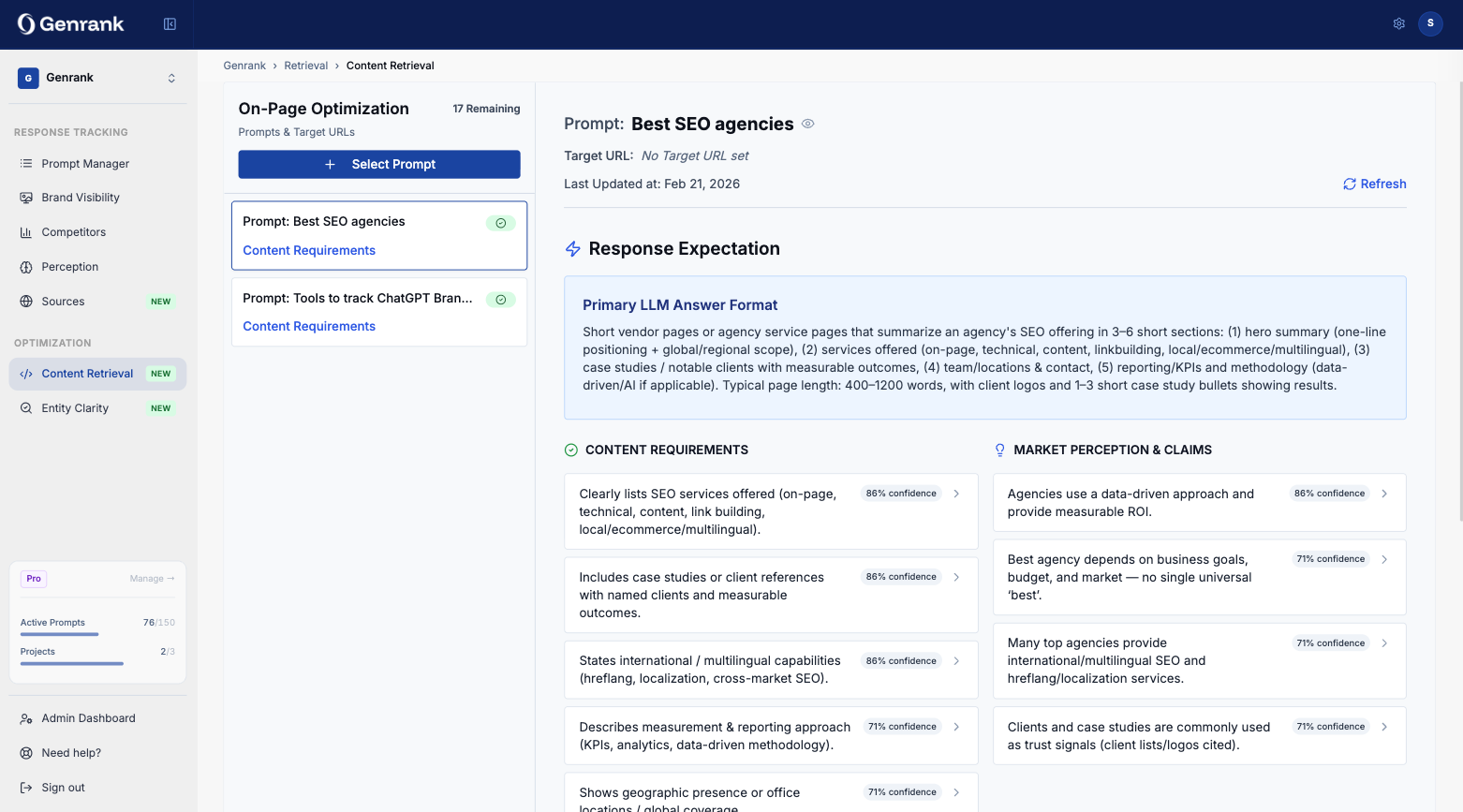
Understand the requirements to get cited for a prompt.
Extract the patterns behind real LLM responses. What format is used? Which claims are repeated? What requirements are implicitly met by the pages that get cited?
We translate those responses into concrete content requirements. Page-checkable elements derived from what AI already selects, combined with URL vector similarity analysis.
Entity Clarity
Make your brand a single, unambiguous entity.
Language models resolve brands as entities. If your name appears in inconsistent forms, overlaps with others, or fragments across variations, recognition weakens.
Entity Clarity measures naming consistency, variation frequency, and fragmentation across responses. You define your canonical entity. We monitor how consistently AI sticks to it.
Strong brands are referenced clearly and repeatedly. If that clarity breaks, you will see it here.
Sentiment Radar
Understand how the web talks about your brand.
Sentiment Radar monitors how your brand is described across non-owned sources and analyzes the tone attached to those mentions. Instead of isolated reputation checks, you see the broader narrative forming around your brand online.
Mentions are grouped across key reputation channels: customer reviews, employee reviews, social platforms, trust and legitimacy signals, and news coverage. This reveals where positive perception is strongest, where criticism concentrates, and which narratives are spreading.
Technical Audit
Identify the domains influencing AI answers.
AI responses often rely on external sources. We track which domains are cited, how frequently they appear, and how they support different brands.
You see which websites shape the narrative in your category and how your own domain performs within that ecosystem.
Expose vector alignment at chunk level.
Simulate how LLMs embed and compare your content to real prompts. At chunk level, you see which sections strongly align and which do not.This reveals structural gaps that keyword tools never surface and shows exactly where content needs reinforcement.
See the dominant claims in your market.
Extract recurring claims from AI responses and see which brands those claims are attributed to. This shows where authority is concentrated and where positioning is being reinforced through repetition. If a claim defines your category, you should control it.
Eliminate entity fragmentation.
Continuously monitor how consistently your brand is referenced across AI outputs. Detect naming variations, alias drift, and structural ambiguity before they weaken recognition. A strong entity is unified. We make sure yours stays that way.
Frequently Asked Questions
Do I need Optimization features?
Tracking shows where you appear. Optimization shows why you appear or why you don’t. It translates AI responses into structural insights and concrete content requirements so you can influence outcomes instead of just observing them.
What are “content requirements” based on AI responses?
We analyze real responses for a prompt and extract recurring patterns: answer formats, claims, definitions, comparisons, attributes, and supporting elements. These patterns become page-checkable requirements. If the pages being cited consistently include certain elements, that is not coincidence. It is a signal.
How is this different from traditional SEO recommendations?
Traditional SEO focuses on keywords and rankings. Optimization in Genrank focuses on retrieval alignment, entity resolution, and structural clarity inside AI systems. It is built around how language models select and generate answers, not how search engines rank links.
What does vector similarity actually tell me?
It shows how closely your content aligns with a prompt at embedding level. We evaluate similarity per content chunk, so you can see which sections are structurally relevant and which are not. This explains why a page is selected or ignored during retrieval.
Why does entity clarity matter?
Language models resolve brands as entities. If your name appears inconsistently or overlaps with variations, recognition weakens. Entity Clarity measures fragmentation and naming consistency so your brand is interpreted as one clear reference point.
Can Optimization influence how AI describes my brand?
Yes. By aligning content with dominant claims, strengthening entity clarity, and improving retrievability, you directly influence which information is selected and how it is framed. AI outputs are shaped by what is retrievable and structurally consistent.
Is this a one-time audit or ongoing process?
Optimization is continuous. AI systems evolve, competitors update content, and prompt landscapes shift. Ongoing monitoring ensures your content remains aligned with the questions and retrieval patterns that drive visibility.
Trusted by over two thousand brands to measure and manage visibility in AI search.