Your Google Search Console already contains long, question-based queries. Genrank identifies those multi-word phrases and surfaces them as ready-to-track prompts.
Instead of starting from zero, you build your AI research layer on proven demand. These are queries users already type into search engines. Many of them are migrating to AI.
You convert search behavior into conversational tracking.
Page Scan
Turn your website into a prompt map.
Page Scan analyzes a URL and generates relevant prompts users are likely to ask ChatGPT about that page, product, or brand.
It bridges your existing content with conversational behavior. Instead of inventing prompts manually, you get structured suggestions based on what your site already represents.
Prompt Manager
Control the prompts that shape your data.
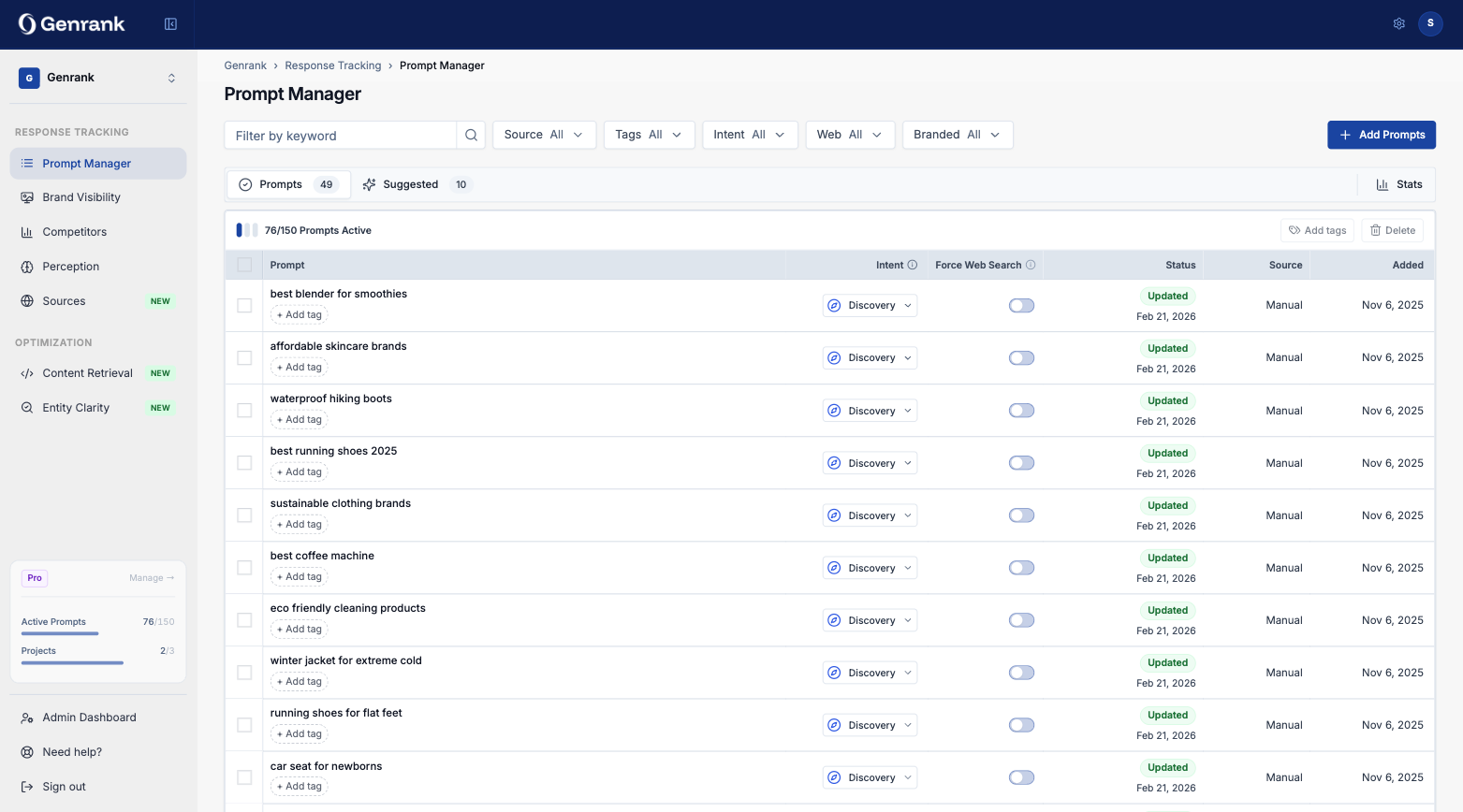
You create, import, tag, and monitor prompts in a structured environment. Each prompt is categorized by intent, source, and status so your tracking is organized and scalable.
This is where you decide exactly which conversations matter to your business. Every metric in Genrank is based on prompts you intentionally define.
Technical Audit
Identify the domains influencing AI answers.
AI responses often rely on external sources. We track which domains are cited, how frequently they appear, and how they support different brands.
You see which websites shape the narrative in your category and how your own domain performs within that ecosystem.
Control web retrieval behavior.
Choose whether prompts should force the web search mode in ChatGPT.
This allows you to test visibility both with and without retrieval, giving you deeper insight into how your brand performs across configurations and how external sources influence the response.
Organize prompts by intent
Categorize every prompt by discovery, comparison, transactional, branded, or custom intent. This allows you to analyze visibility by funnel stage and understand where you dominate and where you disappear.
Add prompts at scale.
Import and manage large prompt sets without friction.Bulk additions make it possible to move from experimentation to structured coverage quickly.
Frequently Asked Questions
Why is prompt selection so important?
AI visibility is context-dependent. Your brand may appear in one type of query and be absent in another. Prompt Research ensures you track the exact conversations that influence discovery, comparison, and buying decisions in your category.
How do I know which prompts to track?
You don’t start from guesswork. Page Scan generates prompts from your own URLs. Search Console Extractor surfaces real multi-word queries from your search data. SEO Keyword Converter adapts existing keyword research to conversational format. You build from signals you already own.
Can I structure prompts by funnel stage or intent?
Yes. Prompts can be categorized by intent so you can analyze visibility across discovery, comparison, transactional, or branded queries. This reveals where you dominate and where you are underrepresented.
What is the difference between a keyword and a prompt?
Keywords are fragmented. Prompts are natural, contextual questions or instructions. AI systems respond to prompts, not keyword strings. Converting keywords into realistic prompts ensures your tracking reflects actual AI behavior.
Why would I force web search mode?
AI responses differ when web retrieval is enabled. For certain prompts, forcing web search helps you understand how your brand performs when external sources are actively pulled in. This gives you a clearer view of retrieval-driven visibility.
Can I scale this beyond a handful of prompts?
Yes. Prompts can be added in bulk and managed centrally. This allows you to move from limited testing to structured coverage across your full category. Our custom plan offers unlimited prompt slots with usage based billing.
Is this a one-time setup?
No. Prompt landscapes evolve as products, competitors, and user behavior change. Prompt Research is an ongoing process to ensure your tracking reflects real market conversations.
Trusted by over two thousand brands to measure and manage visibility in AI search.