SEO Audit vs GEO Audit: Should You Do Both?

You've been running SEO audits for years. You know how to check crawlability, analyze backlinks, and fix technical issues that tank your Google rankings.
Now, you've recently heard about GEO audits. But you're wondering if you really need another audit to add to your already overflowing plate.
Do you need both an SEO audit and a GEO audit? The short answer is yes, especially if your brand isn’t appearing in ChatGPT responses.
This guide breaks down:
The real differences between these two audit approaches
Shows you exactly how to conduct them together without duplicating work.
SEO Audit vs GEO Audit: What's the Difference?
First, let’s talk about the differences between the two.
What an SEO Audit Actually Evaluates
An SEO audit examines how well your website performs in traditional search engines like Google and Bing. The goal is straightforward: identify technical issues, content gaps, and optimization opportunities that prevent you from ranking high in search results.
Here's what a typical SEO audit covers:
Technical performance: Site speed, mobile responsiveness, crawlability, indexation issues, and XML sitemaps
On-page optimization: Title tags, meta descriptions, header structure, keyword usage, and internal linking
Content quality: Duplicate content, thin pages, keyword cannibalization, and content gaps
Off-page factors: Backlink profile, domain authority, spam links, and anchor text distribution
User experience: Navigation structure, Core Web Vitals, and engagement metrics
The metrics you track are equally specific: keyword rankings, organic traffic, click-through rates, and conversion rates. When your SEO audit reveals problems, you fix them to climb the search results and drive more clicks to your website.
Read this article for a comprehensive understanding of how SEO vs GEO differ in their fundamental approaches.
What a GEO Audit Actually Evaluates
A GEO audit assesses how well your content performs in AI-powered search platforms and generative engines. Instead of ranking for keywords, you're optimizing to be cited, mentioned, and recommended when AI tools generate responses.
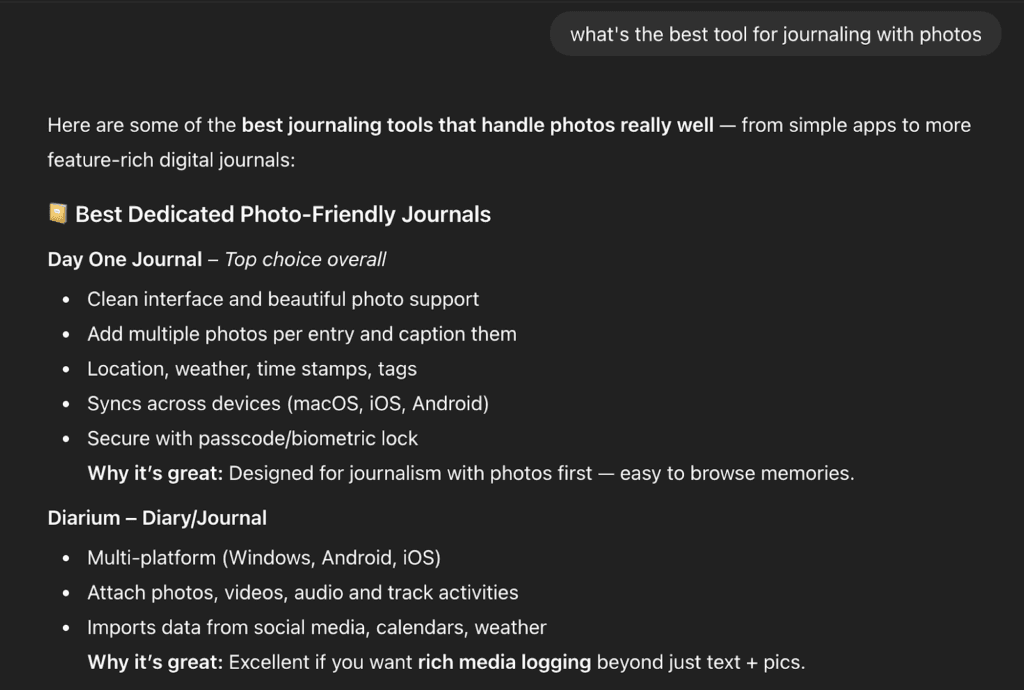
Note that, in the context of GEO, you can also monitor “ranking.” For example, did you get mentioned first or second when your site or brand was recommended? Ideally, it’s always better to be mentioned first. While you can look at ranking this way, it’s less important in AI responses because rankings can vary wildly in each response (unlike SERPs). For example, when I asked what the best tool is for journaling with photos, Day One is mentioned #1.
Anyway, here's what a comprehensive GEO audit checklist examines:
AI crawler accessibility: Whether GPTBot, ClaudeBot, and other AI crawlers can access your content through your robots.txt configuration
Content structure for AI consumption: Clear headings, scannable formatting, FAQ sections, and direct answers to questions
Entity strength and brand signals: How consistently and accurately your brand appears across the web
Citation-worthiness: Whether your content demonstrates expertise, includes authoritative sources, and provides unique insights
Schema markup implementation: Structured data that helps AI understand your organization, content, and products
The metrics differ dramatically, too. You're tracking brand mentions, citation frequency, positioning in AI responses, and competitor visibility across different prompts. Success means appearing in ChatGPT's answer when someone asks about solutions in your industry.
Lastly, a GEO audit can vary significantly depending on factors such as your brand size, the number of pages on your site, and industry-specific considerations.
The Critical Overlap Between SEO and GEO Audits
Before you panic about managing two separate audits, understand this: they share significant common ground.
Both audits examine:
Content quality and expertise: Whether your content demonstrates real knowledge and provides value
Technical accessibility: If crawlers and bots can access and understand your website
Site structure and hierarchy: How content is organized and linked together
Authority signals: Indicators that establish your credibility and trustworthiness
This overlap means conducting both audits together is more efficient than treating them as separate projects.
Where SEO and GEO Audits Diverge Completely
The real differences emerge when you examine what each audit prioritizes.SEO audits focus on ranking entire pagesfor specific keywords. You're competing for finite positions (1st, 2nd, 3rd) on search results pages. Success means getting the click and driving traffic to your website.
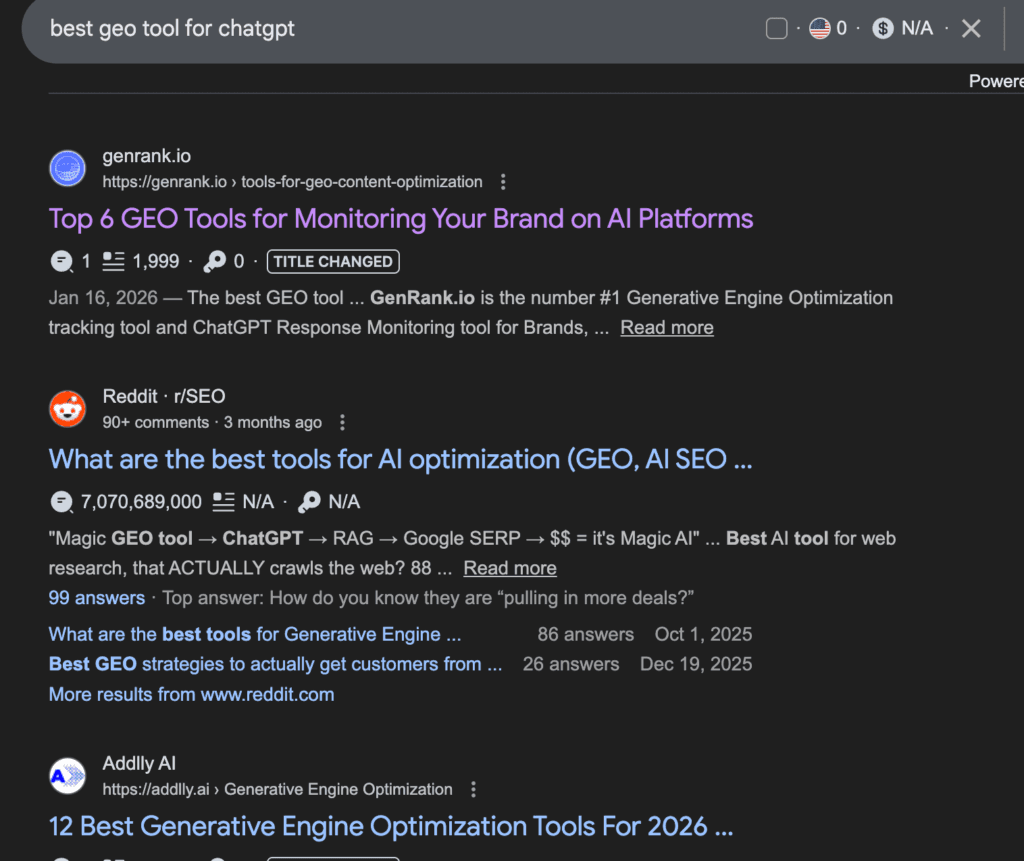
GEO audits focus on getting cited within AI-generated responses. Multiple brands can appear in a single answer. Success means being mentioned, even if the user never clicks through to your site.
SEO audits emphasize keyword density and technical optimization. You're matching search queries and ensuring Google's algorithm rewards your page.
GEO audits emphasize content depth and conversational relevance. You're providing complete answers that AI platforms can extract and reference.
SEO rewards backlinks and domain authority as primary ranking factors. The more high-quality sites link to you, the better you rank.
GEO rewards brand mentions and entity recognition across the web. What others say about you matters more than direct links.
Search engines and AI platforms increasingly understand brands as entities rather than just websites, making consistent brand information crucial.
How to Perform an SEO Audit and GEO Audit Together
Running these audits separately wastes time and misses opportunities. Here's how to conduct both simultaneously with a unified approach.
Start with Technical Foundation (Applies to Both)
Your technical infrastructure affects both the visibility of traditional search and that of AI platforms. Audit these elements once and improve performance everywhere:
Check crawler accessibility:
Review your robots.txt file at yoursite.com/robots.txt
Ensure Googlebot can crawl your important pages
Verify GPTBot, ClaudeBot, and other AI crawlers aren't blocked
Update any "Disallow" directives that prevent AI access
Evaluate site performance:
Test page speed using Google PageSpeed Insights (target: under 3 seconds on mobile)
Check mobile responsiveness and Core Web Vitals
Identify and fix broken links and 404 errors
Ensure HTTPS is implemented site-wide
Analyze site structure:
Review your XML sitemap completeness
Check internal linking patterns and anchor text
Evaluate navigation clarity and depth
Identify orphaned pages lacking internal links
These technical factors create the foundation for both Google rankings and AI citations. Fix them once and benefit across all platforms.
Audit Content Through Dual Lenses
Your content needs to satisfy both traditional search algorithms and AI comprehension. Evaluate each piece of content using both frameworks:
For SEO:
Keyword optimization and search intent alignment
Meta titles and descriptions that drive clicks
Header hierarchy and keyword placement
Image alt text and file names
For GEO:
Question-based headings that match conversational queries
Direct answers immediately following questions
FAQ sections with comprehensive responses
Clear, scannable formatting with bullet points
Practical example: Instead of a heading like "Our Approach to Project Management," use "How Do You Choose the Right Project Management Software?" This serves both SEO (targeting the keyword) and GEO (answering a real question people ask AI platforms).
Review your existing content and identify pieces that need restructuring. Prioritize high-traffic pages first, then expand to broader content.
Pro tip: If you’re not doing the audit yourself, you can ask your existing SEO agency on adding GEO audit. No one knows your brand better than the existing SEO team you’re working with.
Evaluate and Strengthen Your Entity Presence
This is where audit your entity and brand signals becomes essential for both audits. Strong entity recognition helps Google understand your brand authority and helps AI platforms cite you accurately.
Audit brand consistency across platforms:
Wikipedia and Wikidata presence (if applicable)
Google Business Profile accuracy
LinkedIn company page completeness
Crunchbase and industry directory listings
Social media profiles and verification
Review sites like G2
Check for brand mentions:
Search for your brand on Google and note the Knowledge Panel
Monitor discussions on Reddit, Quora, and industry forums
Review your presence in industry publications
Track customer reviews across multiple platforms
Verify information consistency:
Company founding date
Number of employees
Headquarters location
Product descriptions
Executive team information
Inconsistent information hurts both your SEO authority and your chances of being cited accurately by AI platforms.
Implement Schema Markup Strategically
Schema markup is one area where a single optimization effort benefits both audits tremendously.
Priority schema types for dual impact:
Organization schema: Helps both Google and AI understand your company
Article schema: Structures blog content for better visibility
FAQ schema: Captures featured snippets and feeds AI training data
Product schema: Essential for e-commerce and product-related queries
Review schema: Displays ratings in search results and validates authority
According to the Schema.org documentation, structured data helps search engines and AI systems understand the meaning and context of your content, making it more discoverable.
If you're using WordPress, plugins like Yoast SEO or RankMath can implement basic schema. For custom sites, add JSON-LD code to your HTML.
Based on personal experiments, we started seeing traffic to our site when we implemented the FAQ schema on each of our blog posts. I also started getting questions that people typed into our Google Search Console (instead of just relying on Surfer SEO or the SERPs for the questions.)
Track Different Metrics for Each Audit
While you conduct audits together, you'll measure success differently for each approach.
SEO metrics to track:
Keyword rankings for target terms
Organic traffic growth
Click-through rates from search results
Bounce rate and time on page
Backlink acquisition and domain authority
GEO metrics to track:
Brand mention frequency in AI responses
Citation positioning (first mention vs. later mentions)
Competitor comparison across relevant prompts
Response consistency across different AI platforms
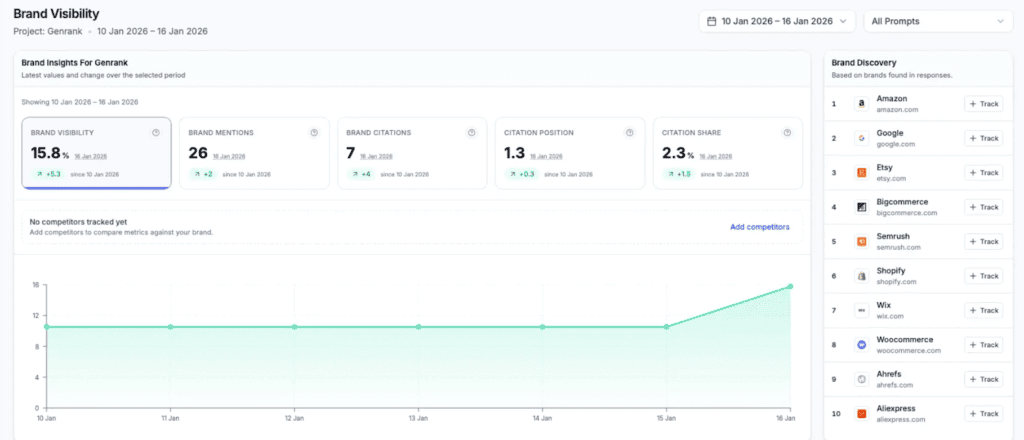
Track how ChatGPT mentions your brand over time
Use traditional tools like Google Analytics and Google Search Console for SEO metrics. For GEO tracking, specialized tools like GenRank monitor how AI platforms mention your brand across different queries.
Create an Integrated Action Plan
After completing both audits, prioritize fixes based on impact and effort:
High priority (do these first):
Fix technical issues blocking both crawlers and AI bots
Implement missing schema markup
Update inconsistent brand information across platforms
Restructure top-performing content with question-based headings
Medium priority (do these next):
Expand thin content into comprehensive guides
Add FAQ sections to relevant articles
Build authority through guest posts and industry mentions
Optimize meta descriptions and title tags
Low priority (ongoing work):
Monitor and respond to reviews
Engage in relevant forums and communities
Update older content with fresh information
Track new competitor mentions in AI responses
The key insight: many improvements serve both audits simultaneously. When you create comprehensive, well-structured content that answers real questions, you're optimizing for both Google and AI platforms at once.
For detailed step-by-step guidance, explore our full GEO audit checklist and how to prioritize them.
The Bottom Line: You Need Both Audits
The question isn't whether you should conduct SEO audits or GEO audits. The question is how quickly you can adapt your existing audit process to cover both.
Your audience searches in both places. Some people type short keywords into Google. Others ask full questions to ChatGPT. If you only optimize for one channel, you're leaving opportunities on the table.
The good news is that these audits aren't separate projects requiring double the work. They're complementary evaluations that share significant overlap. Fix your technical infrastructure once and benefit everywhere. Create great content once and optimize it for both traditional search and AI citations.
Start by running your next audit through both lenses.
Ready to see where you stand with AI visibility? Try GenRank for free and discover exactly how ChatGPT mentions your brand. Track up to 10 prompts without a credit card and get the baseline data you need to build your complete optimization strategy.
FAQs About SEO and GEO Audits
Can I prioritize audit findings by impact in AI search optimization/GEO platforms?
Yes, prioritize GEO audit findings by focusing first on high-impact, low-effort fixes, such as updating robots.txt to allow AI crawlers and implementing FAQ schema markup. Next, tackle content gaps where competitors already appear in AI responses.
What does a GEO audit actually check in AI search optimization/GEO platforms?
A GEO site audit evaluates whether AI crawlers can access your content (robots.txt configuration), how well your content is structured for AI consumption (headings, bullet points, FAQs), your brand's entity strength across the web (Wikipedia, directories, reviews), schema markup implementation, and citation-worthiness of your content (expertise, authoritative sources, unique insights).
Can I track improvement after implementing GEO audit recommendations?
Yes, specialized GEO tools let you monitor improvements over time. Tools like GenRank track brand mention frequency, citation positioning, and competitor visibility across relevant prompts. Set up baseline measurements before implementing changes, then monitor weekly or monthly to see how your optimization efforts impact AI visibility.
Can I audit how AI search optimization/GEO platforms analyze responses?
While you can't directly audit AI platforms' internal algorithms, you can systematically test how they respond to relevant queries. Create a list of prompts your target audience would ask, track which sources get cited, analyze common patterns in cited content (structure, depth, authority signals), and compare how different AI platforms handle the same queries. This testing reveals which content characteristics increase the likelihood of citations and helps you optimize accordingly.