How to Track Your Rankings on ChatGPT Over Time

You know you should be tracking your ChatGPT visibility. But every time you manually type prompts into ChatGPT, you get different results. Yesterday, your brand was mentioned first. Today it's buried at the bottom. Tomorrow it might not appear at all.
So the question becomes: should you even be tracking ChatGPT "rankings" if they're this inconsistent? And if so, how do you track something that seems to change constantly?
Here's why it matters: ChatGPT handles over 2.5 billion queries daily. According to recent research, 55% of users now turn to AI for search rather than traditional search engines. Your potential customers are asking ChatGPT for product recommendations, comparing solutions, and making buying decisions without ever opening Google.
If you're not tracking how ChatGPT mentions your brand (or whether it mentions you at all), you're invisible to this massive and growing segment of buyers.
The good news? You don't need to manually test prompts every day or drive yourself crazy with inconsistent results. There's a systematic way to track your ChatGPT visibility over time and actually measure what's working.
In this guide, you'll learn:
What "ranking" actually means on ChatGPT (hint: it's not about position #1, #2, #3)
How to conduct a GEO audit to establish your baseline visibility
How to track your ChatGPT mentions over time using both manual and automated methods
What metrics actually matter beyond basic brand mentions
How to turn tracking data into actionable improvements that increase your AI visibility
Let's start by understanding what we're actually tracking.
What Does Ranking Mean on ChatGPT?
Traditional SEO rankings are straightforward. You either rank #1 for "best project management software" or you don't.
ChatGPT works differently.
When someone asks ChatGPT a question, it generates a unique response that might mention multiple brands.
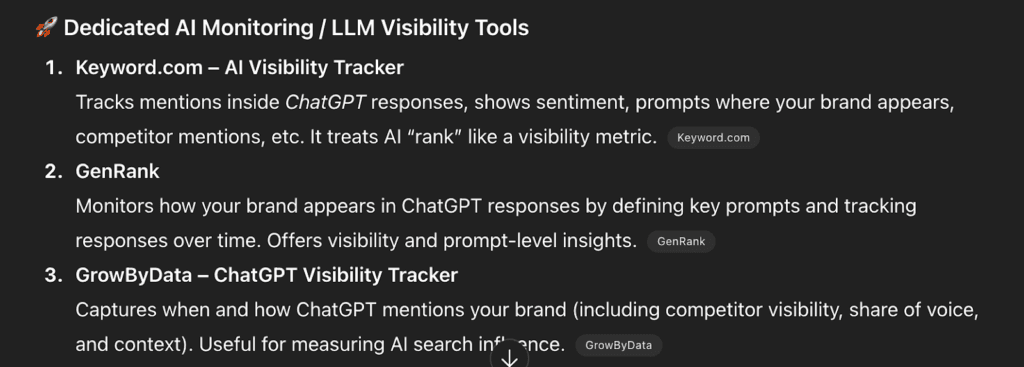
Your "ranking" isn't about occupying a fixed position, it's about:
Whether you're mentioned at all in relevant responses
How frequently you appear across similar queries
Where you're positioned in the response (first mention vs. buried at the end)
Whether you get a clickable citation linking to your website
The context surrounding your brand mention
Think of it like this: instead of competing for the #1 spot on a search results page, you're competing for share of voice in AI-generated answers.
The Two Types of ChatGPT Mentions
Your brand can get mentioned in two ways in a conversation with ChatGPT:
Text-based brand mentions: ChatGPT includes your brand name naturally in its response. For example: "Popular project management tools include Asana, Monday.com, and Trello."
Citations with source links: When ChatGPT uses web search functionality, it can cite your website directly with clickable links. These are more valuable because they drive actual traffic.
Both matter. And you want to increase your chances in all of ChatGPT’s responses.
How to Do a GEO Audit
Before you start tracking your ChatGPT "rankings" over time, you need to understand your current visibility. This is where a GEO audit comes in.
A GEO (Generative Engine Optimization) audit evaluates how well your website and content are optimized for AI platforms like ChatGPT. Unlike traditional SEO audits that focus on search rankings and technical performance, a GEO audit examines whether AI systems can access, understand, and cite your content.
Here’s the general checklist for a GEO audit:
Check if AI crawlers can access your site: Go to yoursite.com/robots.txt and ensure GPTBot and other AI crawlers aren't blocked. If you see "Disallow: /" for these bots, update your robots.txt to "Allow: /" so AI platforms can discover your content.
Audit your content structure: Review your existing content for clear headings, concise paragraphs, bullet points, and FAQ sections. AI platforms prefer content that's easy to parse and skip dense, jargon-heavy content in favor of clearer sources.
Evaluate your brand entity strength: Check if your brand information is consistent across your website, LinkedIn, Google Business Profile, industry directories, and review sites. Inconsistent information (different founding dates, conflicting descriptions, varying employee counts) confuses AI systems and reduces your authority.
Here’s a detailed step-by-step guide on how to do a GEO audit.
How to Track Your Rankings on ChatGPT Over Time
Once you've completed your baseline audit, it's time to implement systematic tracking. You have two options: manual tracking or using a specialized GEO tool.
Manual Tracking (Time-Consuming but Free)
Open ChatGPT and test queries your potential customers would actually ask. Create a spreadsheet to document:
The exact prompt you tested
Date and time of the test
Whether your brand was mentioned (yes/no)
Position in the response (first mention, middle, end)
Type of mention (text only or clickable citation)
Competitors mentioned alongside your brand
Repeat this process weekly or monthly for your key prompts. This gives you a rough sense of trends over time.
The problem? ChatGPT's responses vary by location, user history, and timing. What you see might differ completely from what your customers see. Plus, manually tracking dozens of prompts is tedious and error-prone.
Automated Tracking with a GEO Tool
This is where specialized GEO tools make life dramatically easier. Tools like GenRank automate the entire tracking process.
Here's how it works:
Set up your prompts or queries.
Genrank then fetches this data for you on ChatGPT without logging into ChatGPT.
Get a report, which includes whether your brand and site are mentioned in the responses.
Here’s an example of a report of a prompt we’re tracking. The prompt is “track mentions of brand in chatgpt.”
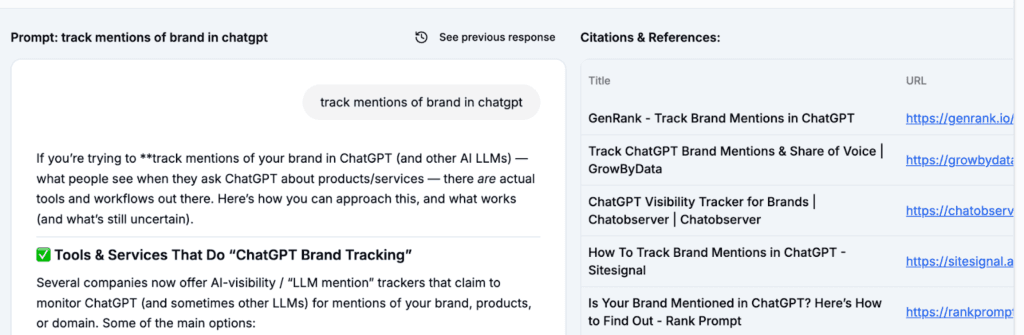
As you can see, Genrank is the #1 citation and brand mentioned in ChatGPT’s response. You can run the same prompt again in the next few weeks or months to see if the brand mentions have changed.
For example, will we stay at #1 in our case? Or will we move lower in the list? This is one of the easiest ways you can track your rankings on ChatGPT over time. Instead of manually doing the prompts, you can just keep fetching the same prompt on Genrank.
Other Key Metrics to Track on ChatGPT
Beyond basic brand mentions and citations, several additional metrics provide deeper insights into your ChatGPT performance.
Context and Sentiment
How ChatGPT talks about your brand matters as much as whether it mentions you. Pay attention to:
Positive context: Is your brand recommended or just listed?
Qualifications: Does ChatGPT include caveats such as "suitable for small teams" or "best for enterprise"?
Comparison context: When mentioned alongside competitors, are you positioned favorably?
For instance, "Asana is excellent for visual project tracking" carries more weight than "Asana is another option."
Topic Coverage
Track which topics consistently generate brand mentions vs. which topics never do. This reveals:
Content gaps: Questions your competitors answer but you don't
Authority areas: Topics where you dominate ChatGPT responses
New opportunities: Emerging questions you should target with new content
If competitors consistently appear for "best CRM for startups" but you don't, that's a clear signal to create comprehensive startup-focused content.
Traffic from ChatGPT
When ChatGPT cites your website with a clickable link, it can drive actual traffic. Set up tracking in Google Analytics to measure:
Sessions from ChatGPT: Look for utm_source=chatgpt in your traffic reports
Engagement metrics: How do ChatGPT visitors behave compared to Google traffic?
Conversion rate: Are ChatGPT referrals turning into customers?
This connects your ChatGPT visibility to real business outcomes, making it easier to justify GEO investments.
Competitor Benchmark Data
Track not just your performance, but your competitors'. Monitor:
Competitor mention frequency: Which rivals appear most often?
Their positioning: Are they always first or buried lower in responses?
Topics they own: Where do competitors dominate that you don't?
This competitive intelligence helps you identify optimization opportunities and understand the overall landscape.
Trend Analysis Over Time
The real value comes from tracking changes week over week and month over month. Look for:
Improving trends: Are your mentions increasing after content updates?
Declining visibility: Did a competitor's new content push you out?
Seasonal patterns: Do certain prompts perform better at different times?
Content impact: Does publishing new content correlate with improved mentions?
Continuous monitoring helps you understand what's working and what needs adjustment.
Start Tracking Today
Tracking your ChatGPT "rankings" isn't optional anymore. With more people turning to AI for recommendations, understanding your visibility in these platforms determines whether you're part of the consideration set or completely invisible.
The brands dominating ChatGPT mentions didn't get there by accident. They started tracking, learned what worked, and adjusted their content strategy accordingly.
Start with a baseline GEO audit to understand your current standing. Then implement consistent tracking using either manual methods or a dedicated GEO tool to measure progress over time.
Ready to see where you stand? Try GenRank for free and track up to 10 prompts without a credit card. You'll discover exactly how ChatGPT mentions your brand and what opportunities you're missing.
FAQs About Tracking ChatGPT Rankings
How to rank #1 in ChatGPT?
ChatGPT doesn't have fixed rankings like Google. Instead, focus on increasing your brand mention frequency and positioning. Create comprehensive, authoritative content that directly answers common questions. Implement FAQ schema markup, ensure AI crawlers can access your site, and build consistent brand mentions across authoritative platforms.
What is a ChatGPT rank tool?
A ChatGPT rank tool (also called a GEO tool) monitors how AI platforms like ChatGPT mention your brand across different queries. These tools automate prompt testing, track brand mentions over time, compare your visibility against competitors, and measure whether you're getting text mentions or clickable citations. For example, GenRank is a specialized ChatGPT tracking tool that monitors brand mentions and citations.
What is a rank tracker for ChatGPT?
A rank tracker for ChatGPT monitors your brand's visibility in AI-generated responses over time. Unlike traditional SEO rank trackers that measure position #1-10, ChatGPT rank trackers measure mention frequency, citation quality, and positioning within responses.
How often should I track my ChatGPT rankings?
Track your key prompts at least weekly for critical queries and monthly for broader monitoring. Automated GEO tools make frequent tracking practical without manual effort. More frequent tracking helps you spot trends quickly and correlate changes with your optimization efforts. Frequency also depends on how fast your industry moves.