Why Isn't ChatGPT Mentioning My Company?

Did someone tell you that they can’t find you on ChatGPT? Or maybe you tested out some prompts, and your company didn’t show up at all. You might be wondering, “Why isn’t ChatGPT mentioning my company?”
There are several reasons why your company isn’t showing up on ChatGPT. In this blog post, we’ll cover potential reasons and share some quick tips on how to fix them.
But first things first…
How Do You Know That ChatGPT Isn't Mentioning Your Company?
Are you 100% sure that your company isn’t mentioned in ChatGPT?
You might have stumbled onto this realization in a few ways. Maybe a colleague casually mentioned asking ChatGPT for tool recommendations,f and your company wasn't mentioned.
Or perhaps you tested it yourself, typed in a question about your industry, and watched ChatGPT recommend everyone except you.
Manually Checking on ChatGPT
Open ChatGPT and start asking questions your potential customers would ask. Try variations like:
"What are the best [your product category] for [specific use case]?"
"Who are the top companies in [your industry]?"
"What are alternatives to [your main competitor]?"
You can also ask ChatGPT directly. What do you know about [your brand]?
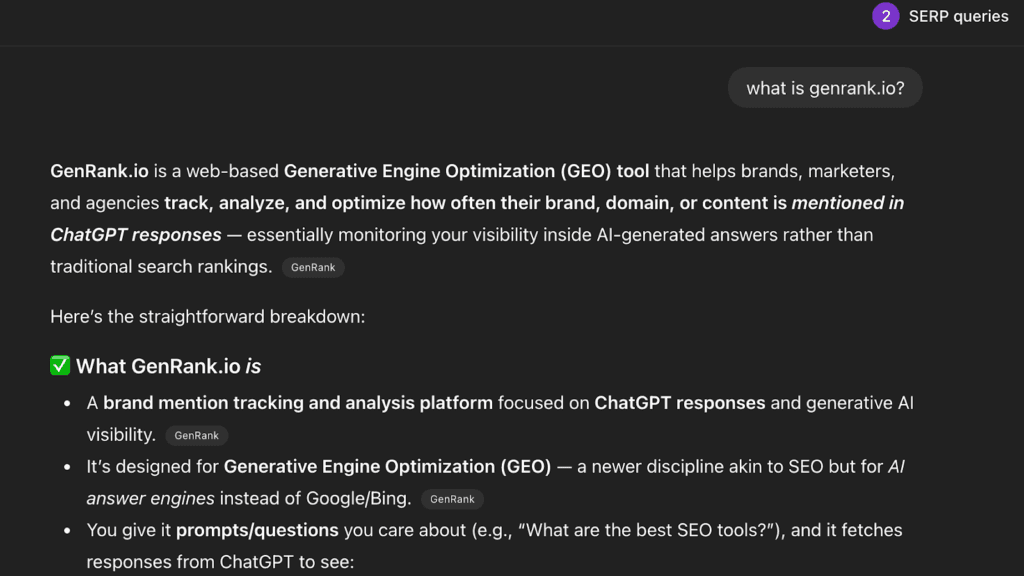
You’ll know what kind of information it has about your company. Is it outdated information? Where is it coming from?
Do this across different question formats. Sometimes ChatGPT mentions you for one type of question but not another.
The problem with manual testing? It's time-consuming, inconsistent, and doesn't give you historical data. You're getting a snapshot of right now, but you have no idea if things are getting better or worse over time.
Using a GEO Tool
This is where a GEO tool makes life easier. Tools like GenRank let you set up the prompts your customers are likely asking, then automatically track whether your company appears in ChatGPT's responses.
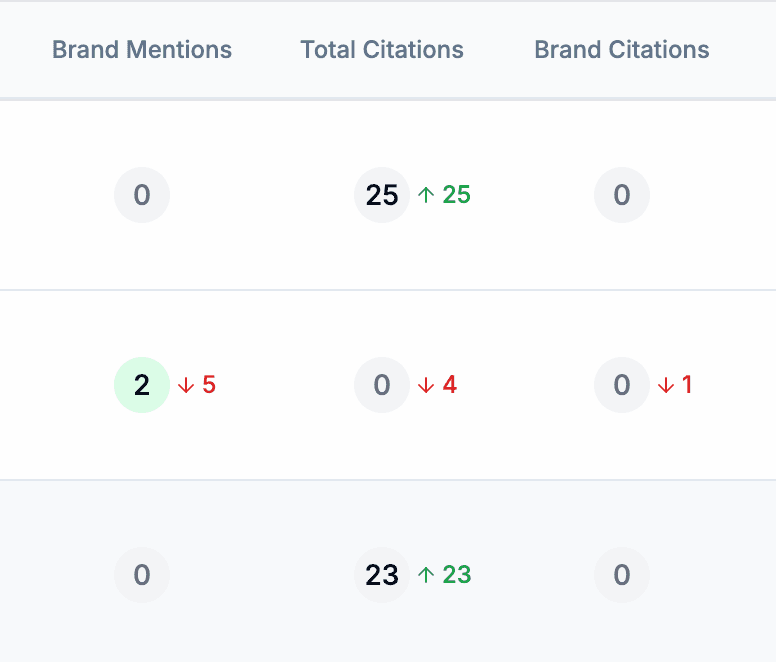
You can monitor:
How often your brand gets mentioned across different prompts
Where you appear in ChatGPT's responses (first mention vs. buried at the end)
How your competitors are performing on the same prompts
Changes over time as you implement optimizations
Once you know for sure that your site or your brand isn’t mentioned in any prompts you’ve typed manually or in Genrank, it’s time to troubleshoot.
You Might Be Preventing AI Crawlers on Your Site
Your site is perfectly optimized for Google, but you're accidentally blocking the very bots that help ChatGPT discover your content.
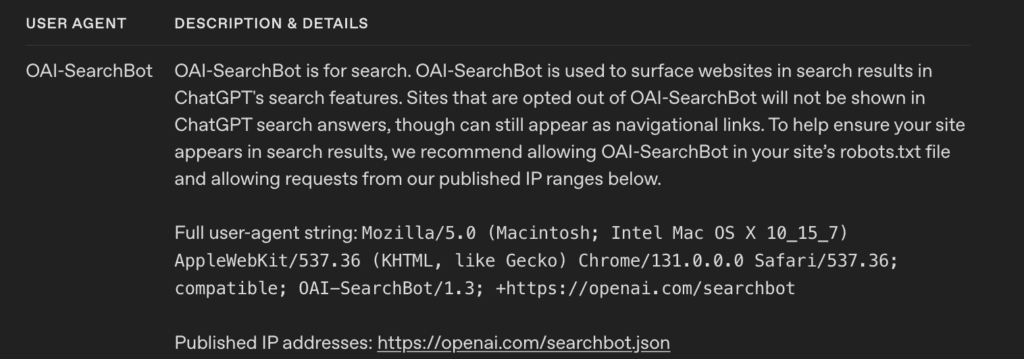
ChatGPT uses specialized crawlers like GPTBot to access and analyze web content. If your robots.txt file blocks these crawlers, your site becomes invisible to AI platforms, no matter how amazing your content is.
How to check if you're blocking AI crawlers:
Go to yoursite.com/robots.txt and look for lines like these:
User-agent: GPTBot
Disallow: /
If you see "Disallow: /" for GPTBot, ClaudeBot, or other AI crawlers, you're telling them to stay away.
The fix is straightforward:
Update your robots.txt file to allow AI crawlers. Instead of blocking them, you want something like this:
User-agent: GPTBot
Allow: /
This simple change tells AI platforms they're welcome to crawl and learn from your content. If you're not sure how to properly configure this, read our detailed guide on optimizing your robots.txt file for AI crawlers.
You’re Not Publishing Blog Posts that Answer Specific Questions
LLMs like ChatGPT like to reference question-based content. That’s because most of the prompts are a long string of questions.
Take this blog post as an example. It’s a specific question: Why isn’t ChatGPT mentioning my company? We found this keyword by understanding what kind of questions our potential customers might ask.
Normally, in traditional SEO, we won’t target this keyword or query because it won’t have a high search volume. But with GEO, we want to target it because it’s a real question from a real user. It is also high intent. This means the user is already trying to understand how companies appear in ChatGPT responses.
They might be looking for a tool to help them make the process easier. So, how do you find real user questions?
Start with your Google Search Console: Filter all the long questions on your dashboard.
Find questions on Reddit: Go to subreddits where your users might hang out. Check out the real questions they have about your product or service.
Check the Support questions: Are there top-level questions that the team and the knowledge base can’t cover?
Depending on your product and industry, you’ll find more places where you can find real questions from your potential customers. Don’t pass up the opportunity to answer those questions.
The next time a question on ChatGPT pops up, your site might be the only site that covers them in depth.
Read more: Need help creating content that AI platforms actually want to cite? Check out our guide on how to write blog posts that get mentioned in AI responses.
You're Not Implementing Schema Markups
Schema markup is like a translator between your website and AI platforms. It helps ChatGPT understand exactly what your content is about, who you are, and what you offer.
Without schema markup, AI platforms have to guess what your content means. And when they're choosing between your site and a competitor's with clear, structured data, guess who gets cited?
The most important schema types for AI visibility:
Organization schema: Tells AI platforms your company name, logo, contact info, and what you do
Article schema: Helps AI understand the structure and topic of your blog posts
FAQ schema: Makes your question-and-answer content easy for AI to extract and cite
Product schema: Essential if you sell products and want to appear in product-related queries
How to implement schema markup:
If you're using WordPress, plugins like Yoast SEO or Schema Pro can handle this for you. For custom sites, you'll need to add JSON-LD code to your HTML.
Start with the basics: Organization schema on your homepage, Article schema on blog posts, and FAQ schema wherever you have Q&A content.
Your Company Isn’t Mentioned Beyond Your Own Site
AI platforms don't just look at what you say about yourself. They look at what others say about you.
If your company isn't being mentioned in industry publications, review sites, forums, or other authoritative sources, ChatGPT has no external validation that you're worth recommending.
Think of it like asking for restaurant recommendations. Would you trust a place that only talks about how great they are, or would you prefer a spot that has dozens of positive reviews and mentions across different platforms?
Where AI platforms look for validation:
Industry publications: Articles mentioning your company in trade magazines, news sites, or specialized blogs
Review platforms: Trustpilot, G2, Capterra, Google Business Profile reviews
Forums and communities: Reddit discussions, Quora answers, industry-specific forums
Social media: Mentions and discussions on LinkedIn, Twitter, and relevant platforms
Directories: Industry-specific directories, Crunchbase, and local business listings
If you haven’t built any links, the fastest way to do this is to republish your blog posts on other sites, such as Medium and LinkedIn articles. For example, I have a blog post about building an AI agent for LinkedIn. Using Claude Projects, I rewrote it for LinkedIn with a different title and structure. I then linked back to the blog post.
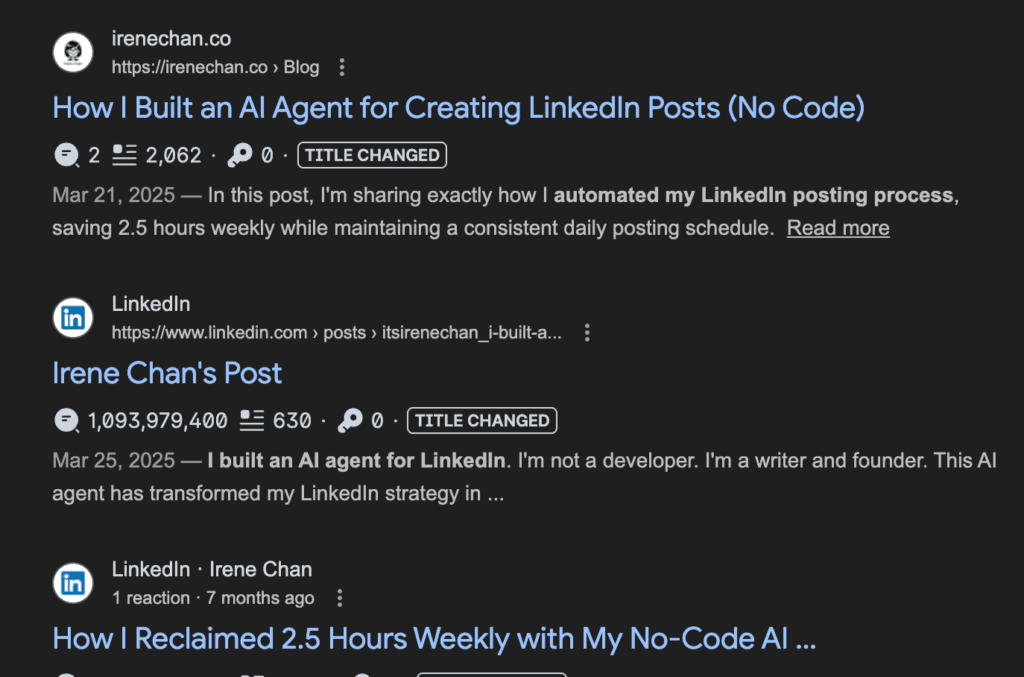
After a few weeks, I can see that the LinkedIn article is also ranked on SERPs and mentioned in ChatGPT.
For a comprehensive look at how to build authority signals, check out our guide on auditing your entity and brand signals.
Inconsistent Information About Your Brand and Site
ChatGPT aggregates information from multiple sources to form an understanding of your company. When those sources contradict each other, AI platforms lose confidence in recommending you.
Imagine if your website says you were founded in 2020, LinkedIn says 2019, and Crunchbase says 2021. Or your website lists 50 employees while your LinkedIn company page shows 20. These inconsistencies create confusion.
Common inconsistency problems:
Founding dates that vary across platforms
Company size numbers that don't match
Location information that's outdated or contradictory
Product descriptions that differ between your site and review platforms
Team information that's current in some places but outdated in others
How to fix brand inconsistencies:
Do a brand audit across all major platforms:
Your website (especially About page)
LinkedIn company page
Google Business Profile
Crunchbase
Industry directories
Review sites
Wikipedia (if you have a page)
Make a spreadsheet with key facts: founding date, number of employees, headquarters location, main products/services, and company description. Then check each platform and update any mismatches.
When ChatGPT encounters consistent information about your company across multiple trusted sources, it increases confidence in citing you. Inconsistencies raise red flags and make AI platforms less likely to mention you at all.
Building a strong, consistent brand entity across platforms becomes crucial as AI platforms like ChatGPT increasingly influence how people discover companies.
Start Fixing Your AI Visibility
Getting mentioned by ChatGPT isn't mysterious or impossible. It comes down to making your company discoverable, trustworthy, and relevant to the questions people are actually asking.
Start with the low-hanging fruit: check your robots.txt file today, update any inconsistent information across platforms, and commit to a consistent publishing schedule. These changes alone can dramatically improve your AI visibility over the next few months.
The companies dominating AI recommendations aren't doing anything magical. They're just making it easy for AI platforms to find them, understand them, and confidently recommend them.
Want to know exactly where you stand? Try GenRank to track how ChatGPT mentions your brand across the prompts that matter to your business. You can't fix what you can't measure.
FAQs
How do you get your business listed on ChatGPT?
You can't directly submit your business to ChatGPT like a directory listing. Instead, ChatGPT learns about your business from its training data and web search. Focus on creating comprehensive, authoritative content on your website, ensuring AI crawlers can access your site, implementing schema markup, and building consistent mentions across authoritative platforms.
How to get ChatGPT to mention your brand?
Getting ChatGPT to mention your brand requires a combination of technical optimization and content strategy. Start by allowing AI crawlers in your robots.txt file, implementing proper schema markup, and ensure your brand information is consistent across all online platforms.
How do I add my company to ChatGPT?
There's no direct submission process to add your company to ChatGPT. The AI learns about companies through publicly available information on the web. To improve your chances of being included, ensure your website is crawlable by AI bots, maintain updated information on major platforms like LinkedIn, Crunchbase, and industry directories, and create valuable content that establishes your expertise.