
Do you research the same way you did before ChatGPT? Most likely, the way you search for information online has significantly changed. You might ask ChatGPT some questions. At other times, you will quickly pull up Google.
This type of search behavior is becoming the norm. And it looks like it’s going to keep changing as top LLMs (large language models) like ChatGPT and Claude continue to improve. On top of that, new tools are being launched almost daily.
But how does this affect you as a marketer or business owner? How does this change in search behavior change the way you strategize content marketing?
In this article, we’ll go over:
- Our traditional search journey
- How the hybrid search journey was born
- Top statistics from trusted sources
- How marketers research new information for content campaigns.
- Content marketing strategies to adapt to the new hybrid search journey
Our Traditional Search Journey
Google, as a search engine, was officially released to the public in 1998. While search engines already existed at that time (such as AltaVista and Yahoo), Google quickly became the top search engine most people used.
Google provided highly relevant results compared to its competitors. Eight years later, the word “Google” was officially recognized as a verb and added to the Oxford Dictionary.
Search Engine Optimization (SEO) was coined around the same time Google was developed. According to Search Engine Land, it “officially” began in 1997.
As consumers used Google to find information, their questions became SEO keywords. We would usually have two types of queries that we would target as SEO professionals:
- Short-tail keywords: These are high-volume, short, and often broad search terms people use (e.g., storage box).
- Long-tail keyword: These are longer, more specific phrases (like a question or a detailed query). They have lower search volume but are less competitive and often signal stronger purchase intent (e.g., rattan storage boxes for small apartments).
For a very long time, those are essentially the two types of keywords. All of them will be typed into Google or any search engine. You’ll get the results in SERPs, and you’ll click the top links to fulfill your search.
For 25 years, we’ve relied on Google to search for information. That changed when LLMS came onto the scene.
The Rise of LLMs
ChatGPT was released in November 2022. At first, it was met with skepticism. But it quickly became everyone’s best friend. People turned to it for brainstorming, writing content, and even creating images.
While LLMs and AI tools already existed before ChatGPT was launched, ChatGPT became the face of the “AI era.”
Five days after its release, it had acquired one million users. As of Feb 2026, it has 800 million weekly active users. According to OpenAI’s study, ChatGPT customers use it to get everyday tasks done, including:
- Practical guidance
- Seeking information
- Writing
“More than one-third of consumers (37%) now begin their searches with AI tools rather than traditional search engines.”
pewresearch.org
Writing is by far the most common work task, ranging from simple follow-up emails to more comprehensive pieces, such as detailed proposals.
As more people use ChatGPT to seek information, search queries are increasingly split between search engines and LLMs.
The Hybrid Search Journey is Born
A hybrid search journey means using both search engines and LLMs to answer questions or research new topics.
For example, before deciding to buy storage boxes, a user might open ChatGPT to brainstorm storage options for their specific space. They might even share a photo of the actual space so ChatGPT can analyze it.
Days later, the user will use Google to type the specific item they need and click the shopping link.
That’s just one example of a hybrid search journey, and sometimes it can be more complex. And in most cases, the search journey might not actually end up in a click.
Here’s how we envision the hybrid search path journey today.
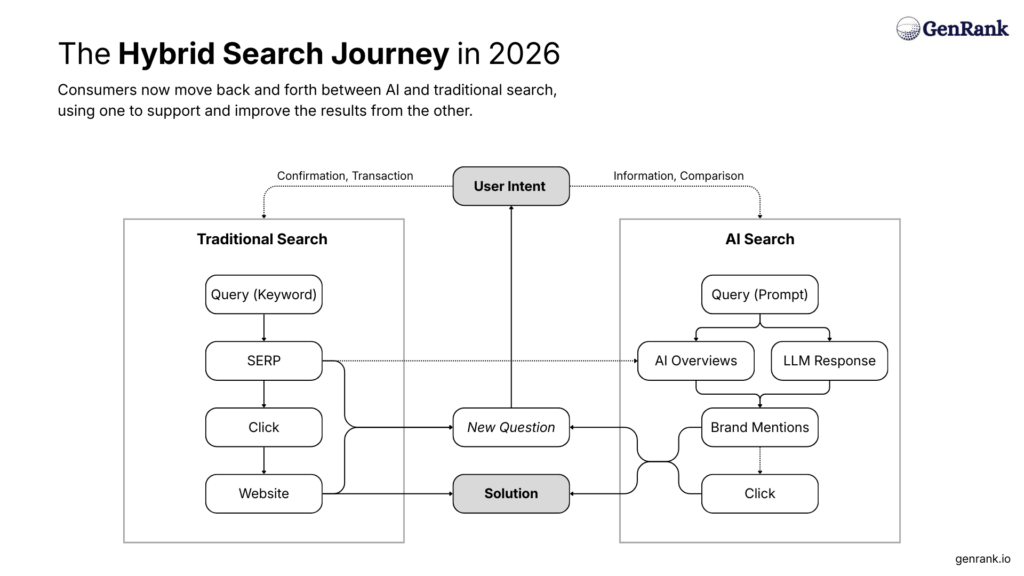
When users want real-time, accurate information without brainstorming, they’ll use Google.
When they have more complex questions that require more branches of thought, they’ll use LLMs like ChatGPT.
For example, if you already know what kind of restaurant you want, you might type, “best Thai restaurants near me” in Google.
But if you’re traveling to a new place and looking for different options, you might start a longer chat with ChatGPT.
Essentially, people haven’t entirely replaced Google with ChatGPT. Each tool has served a specific purpose based on:
- The intent
- Type of question
- Final result
We went beyond short-tail and long-tail keywords. Nowadays, there are keywords and prompts. And not all queries end up in clicks.
This journey isn’t just a fluke. This is the reality in 2026. Understanding this hybrid search journey is critical, especially if you’re a marketer working to acquire users and customers through organic content.
The Hybrid Search Journey: The Real Statistics
Here are some statistics from top sites that showcase how the search journey has become hybrid.
We’ve also included our own small survey of remote marketers around the world to see how their research behavior has changed with the advent of LLMs.
1. Consumers are starting searches with AI instead of Google
More than one-third of consumers (37%) now begin their searches with AI tools rather than traditional search engines, and about 60% say AI delivers better, clearer answers than traditional search, reflecting users’ preference for speed and simplicity over scanning links.
2. AI Overviews significantly reduce organic and paid click-through rates
Google AI Overviews drive a 61% drop in organic click-through rates and a 68% drop in paid CTR on informational queries, indicating users are increasingly satisfied with AI-generated answers.
3. Top organic results lose clicks when AI summaries appear
After the rollout of AI Overviews, the click-through rate for the top organic result dropped from 28% to 19%, a 32% decline compared to traditional search results.
4. Users are far less likely to click links when AI summaries are shown
Google users clicked on a traditional search result link in only 8% of visits when an AI summary appeared, compared with 15% of visits when no AI summary was present.
5. AI summaries increase search sessions that end without further action
Search sessions ended without any further browsing in 26% of visits when AI summaries were shown, compared with 16% of visits without AI summaries.
6. Most searches now end without users clicking through to another site
About 60% of searches now end without the user progressing to another online destination, as consumers increasingly rely on AI-generated summaries to complete their search.
“About 60% of searches now end without the user progressing to another online destination.”
bain.com
7. Marketers are seeing measurable traffic from AI tools
Traffic from large language model platforms such as ChatGPT and Perplexity increased more than 500% year over year, with some websites now receiving over 1% of total sessions from AI tools.
8. 63% of marketers switch between Google and ChatGPT when researching a new topic.
At Genrank, we’ve surveyed marketers composed of SEO specialists, writers, and content managers on how their research behavior has changed when researching a new topic. 63.3% said that they switch between AI and search engines throughout the research process.
Celia Mesa, a content manager and video producer from Barcelona, said:
“I still rely more on Google for academic research and on AI (ChatGPT is my go-to tool) for specific marketing topics or general topics that require less in-depth analysis.”
9. 45.5% of marketers click through fewer sites due to LLMs.
On the other hand, in our same survey, 36% of marketers reported no significant change in how they click sites since ChatGPT came on the scene.
Clicking through sites usually happens when a marketer is more interested in the topic or is looking for specific information or a solution straight from the source.
Erwin Anciano, an SEO writer from the Philippines, shares:
“AI Tools have provided me with much more information at a glance than traditional Google Search does. As a result, I learn more about the topic and end up doing a deeper dive than I used to. The less you know, the less you want to know, but the more you know the more you want to know.”
Adapting to the Hybrid Search Journey: A Hybrid Strategy for Marketers
The shift to a hybrid search journey requires a fundamental rethink of content strategy. As the statistics show, relying solely on attracting clicks from SERPs is no longer sufficient.
Some companies might abandon their SEO efforts entirely in favor of appearing in AI responses. But this strategy will result in further decline in user acquisition from organic search.
The best strategy is to use SEO as the base infrastructure and add layers of GEO strategies. With this hybrid approach, you capture users who are typing transactional search queries in Google and informational questions on AI platforms.
Here are initial strategies that you can start exploring:
1. Optimize for AI Consumption (The ‘Zero-Click’ Strategy)
Since more searches are ending without a click (zero-click searches) due to AI Overviews and summaries, your content must be structured so its key messages are consumed directly by the AI.
- Structured Data and Schema Markup: Ensure your website utilizes proper Schema Markup (e.g., FAQ, HowTo, Product, Article) to clearly delineate the purpose and structure of your content. This makes it easier for LLMs and search engines to extract and summarize key information accurately.
- Direct and Concise Answers: Address common user questions and core topics directly and early in your content. LLMs often pull and paraphrase these definitive statements. Think of your introductory paragraphs and topic sentences as potential AI summary snippets.
- Create ‘Generative Content’ Islands: Develop dedicated, high-authority sections or pages that consolidate data, definitions, or complex explanations. When an LLM needs to synthesize a detailed answer, these islands of high-quality, focused content are more likely to be cited or used as the source for the generative response.
2. Maximize Click Potential (The ‘High-Intent’ Strategy)
While zero-click is on the rise, users still click when they have high purchase intent, need validation, or require real-time/specific information.
- Focus on Commercial and Transactional Queries: Prioritize content for keywords that signal a strong desire to buy, compare, or engage with a service (e.g., “best product for specific use case“, “brand vs competitor“, “service pricing”). These queries are less likely to be fully satisfied by a general AI summary.
- Enhance Trust and Authority Signals: When an LLM summarizes a topic, it often omits the context of trust. To encourage the click:
- Emphasize Expertise, Experience, Authority, and Trustworthiness (E-E-A-T): Clearly highlight authors’ credentials, cite proprietary data, and provide transparent sources.
- Unique Value Proposition: Ensure the organic result description (title tag and meta description) clearly indicates that the linked page offers more than the AI summary, such as proprietary tools, original data, or exclusive insights.
- Content Interoperability: Recognize that the user may start in an LLM and move to Google, or vice versa. Use LLM interactions as a starting point to identify complex, multi-branch questions that require a detailed, human-authored resource. Create content that serves as the definitive deep-dive after the LLM provides the initial overview.
3. Track Hybrid Performance
Traditional SEO metrics (impressions, clicks, rankings) must be supplemented with metrics that track your content’s success in the hybrid environment.
| Metric | Rationale | Actionable Insight |
|---|---|---|
| Generative Visibility Rate | How often your content appears in AI Overviews or LLM citations (Requires third-party tools like Genrank). | Indicates success in the ‘zero-click’ strategy. |
| Share of Voice (LLM) | The percentage of AI-generated responses in your industry that cite your brand/website. | Gauges brand authority in the generative space. |
| Informational vs. Transactional CTR | Comparing the click-through rates of your informational content vs. transactional content. | Helps prioritize content types that are still driving traffic. |
| Query Path Analysis | Analyzing user search behavior that involves both direct visits (from LLMs) and organic clicks (from SERPs). | Reveals how LLMs influence the start of the customer journey. |
By adopting this hybrid strategy, marketers can effectively navigate the evolving search landscape and continue to acquire users and customers.
Next Steps
The “hybrid search journey” is fundamentally changing content acquisition. Users are increasingly turning to AI for immediate, “zero-click” answers, reducing traditional website traffic, especially for informational queries.
To continue succeeding or to at least survive, content marketing must adopt an equally hybrid strategy. Use SEO as your base infrastructure and layer GEO on top of it. This allows you to capture both types of queries and questions from Google and ChatGPT.
Lastly, stay on top of developments in organic search and LLMs. While you don’t have to take action about every little thing, it pays to know when and how to react to the latest developments.
Despite the developments, one thing remains true: content that provides value will still win customers.